

The owners who get the maximum value and general best outcomes in a sale or recapitalization (recap) rarely decide to sell in January. They decide in October and spend the fourth quarter getting ready.
If you own a healthcare services (or adjacent) business and a 2027 sale or recap is on your mind, the next twelve weeks matter more than you might expect. A January launch puts your company in front of investors at the start of their year, with a full year of 2026 results to show. It also leaves room to run a complete process and close within the calendar year.
But investors do not pay for potential they cannot verify. They pay for earnings they can trust, contracts that survive a change of ownership, and a team that keeps running after you step back. Everything below is about making those three things easy to see.
Even if selling isn’t on the immediate radar, every item on this list also makes the business better to own.
1. Clean up the financials
Your financial statements are the first thing a buyer reads and the last thing they stop questioning. Messy books do not just slow a deal down. They lower the price, because uncertainty gets priced as risk.
Start here:
- Close every month on time. Have monthly P&Ls and balance sheets for at least the last three years, plus 2026 year to date. Investors want to see trends by month, not just annual totals.
- Know the gap between cash and accrual. Many practices keep books on a cash basis for tax purposes. Investors underwrite deals on accrual. Ask your accountant what an accrual view of revenue and expenses looks like before a buyer builds their own. If getting from cash to accrual take integration with your billing or EMR system, taking steps to put this in place is highly advised.
- Reconcile revenue to your billing system. Revenue in the general ledger should tie to collections in your practice management system. If it does not, find out why and how you can correct the course.
- Separate business from personal. Identify personal expenses that are specific to the owner or would not go forward as a consequence of a transaction. These expenses can be added back to arrive at your “adjusted EBITDA”, which is the ultimate number that will be applied to a market multiple to get to your company’s valuation.
- Clean up the balance sheet. Resolve old receivables, shareholder loans, stale accruals, and related-party balances. These can become points that slow or complicate the final weeks of a due diligence process, so it pays to address them early.
- Break results out by location and service line. If you have more than one site or program, a buyer will want to have insights into this site and service level data. Granular and bifurcated data can be very valuable to a potential investor, especially if you’re making data driven insights with the data and it is generally trending positive.
2. Identify and document your add-backs
Most lower middle market healthcare businesses are valued on a multiple of adjusted EBITDA. That makes every legitimate add-back worth several times its face value, and every unsupported one a credibility problem.
An add-back is an expense a new owner would not incur. Common ones include:
- Owner compensation above what a replacement would cost
- Personal expenses run through the business, such as vehicles, travel, family payroll, and insurance
- One-time legal, consulting, or recruiting costs
- Startup losses from a new location or service line
- Non-recurring items such as a settlement, a system conversion, or a relocation
- Rent paid to a related entity above market rate
Two rules make add-backs hold up in diligence.
Document each one. Keep a schedule that lists every adjustment by year, with the invoice, payroll record, or ledger detail behind it. An add-back you can prove in five minutes survives. One that relies on memory usually does not.
Be honest about the adjustments that cut the other way. If you are a clinician-owner who sees patients and takes little salary, a buyer will subtract the cost of replacing your clinical work. The same applies to below-market rent or a family member working for free. Investors find every time. Presenting them yourself builds trust and keeps you in control of the number.
3. Pull your key contracts
The purpose of gathering contracts now is not filing. It is finding out what happens to each one when ownership changes.
Collect signed, current copies of the following:
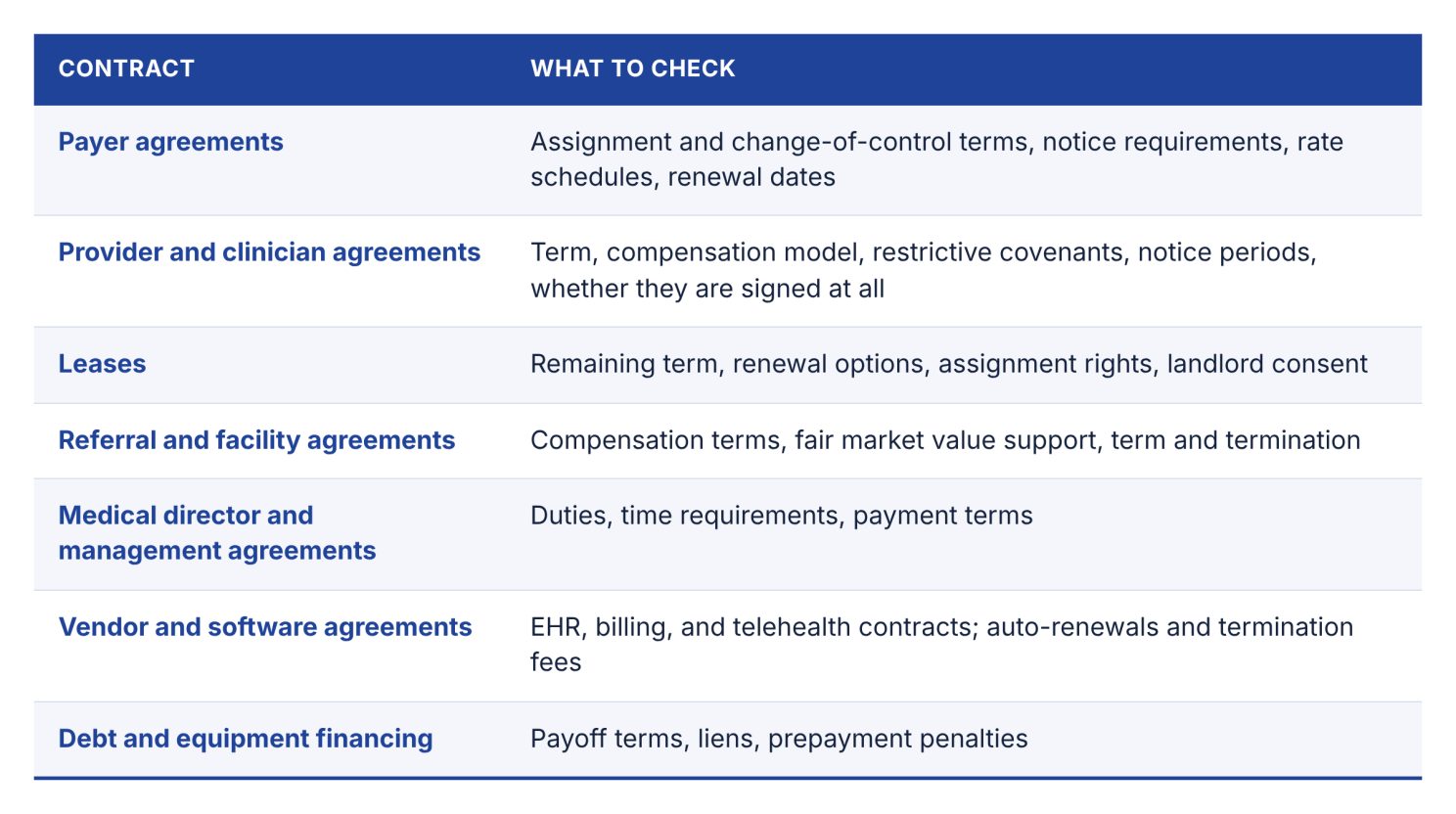
Three problems come up repeatedly. Agreements that expired years ago and were never renewed. Provider agreements that were never signed. Payer contracts that require consent to transfer, which can affect how a deal must be structured.
None of these kills a deal when found when preemptively prepping for a deal. Any of them can stall one when found during diligence. Have your healthcare attorney review the short list of contracts that drive most of your revenue.
4. Review your payer mix and revenue quality
In healthcare services, where your revenue comes from matters as much as how much there is. Two businesses with identical EBITDA can trade at very different values because of who pays them.
Build a clear picture of the following before a buyer asks:
- Revenue by payer. For each of the last three years: commercial, Medicare, Medicaid, self-pay/cash, and any contract or grant revenue.
- Concentration. What share of revenue comes from your largest payer, your largest referral source, and your largest contract? Investors start asking hard questions when any single one carries a large share.
- Nature of patient visits and panel health. How frequent do you patients visit and how long have patients stayed with you? What is the yearly retention rate for patients.
- Reimbursement by payer for your top service codes. Know which contracts are above or below your average, and when each was last renegotiated.
- Collections performance. Net collection rate, denial rate, days in accounts receivable, and an aging report by payer.
- Out-of-network and single-case exposure. Revenue that depends on out-of-network billing or one-off agreements is discounted heavily.
- Volume trends. Visits, census, or encounters by month, by site, and by provider.
Some of this can be improved in a quarter. A rate renegotiation that is overdue, a credentialing backlog, or a denial problem with one payer are all fixable before launch. What cannot be fixed can be explained, and a known issue with a clear explanation is far less costly than a surprise.
5. Think about management depth
The question every buyer is really asking is simple. What happens to this business when the owner is no longer in the building?
If the honest answer is that referrals, payer relationships, clinical oversight, and hiring all run through you, the buyer has two choices. They can pay less, or they can tie more of your proceeds to an earnout and a longer stay. Neither is what most owners want.
You cannot build a management team in twelve weeks, but you can make real progress:
- Map who does what. Write down every function you personally handle. Then mark which ones someone else could own by January.
- Hand off two or three of them now. A handoff that has been working for three months is evidence. A plan to hand off after closing is a promise.
- Identify your second tier. Who runs clinical operations, billing, and day-to-day administration? Investors will want to meet them, and their tenure and capability show up in the valuation.
- Introduce others to key relationships. If you are the only person your top referral sources know, start bringing a colleague to those meetings.
- Write down how things work. Intake, scheduling, billing, credentialing, and compliance processes that exist only in someone’s head are a risk.
- Think about retention. Consider which employees are essential to a transition and how you might keep them through it. Your advisor and attorney can help you structure this.
Also decide who needs to know. Most owners bring in one or two trusted people early, usually whoever runs finance and operations, and keep the circle small until much later.
Seven more things worth doing in Q4
The five items above are the foundation. These seven separate a business that is ready for an M&A process from one that is merely willing.
Run a compliance check before a buyer does
Healthcare diligence goes deeper on compliance than almost any other sector, and findings here can change price, structure, or the buyer’s willingness to proceed. Consider an outside billing and coding audit on a sample of claims. Confirm that licenses, accreditations, and provider credentialing are current. Check that your HIPAA risk assessment is up to date, and that employees and contractors are screened against federal exclusion lists. Ask your healthcare attorney to look at referral arrangements and your ownership structure under your state’s rules.
Get your provider data in order
Clinicians are the asset in most healthcare services businesses. Build a roster showing each provider’s start date, license, compensation, productivity, and contract status. Know your turnover for the last three years and what your open positions are. If a key clinician is working without a current agreement, fix that now.
Build a one-page KPI view
Investors think in metrics. Pull the ten or so numbers that describe your business on one page, by month: visits or census, new patients, revenue per visit, provider productivity, no-show rate, collections, and wait times or occupancy where relevant. If you do not track these today, starting now gives you a quarter of data by launch.
Understand your working capital
Most deals include a working capital target, and the gap between that target and what is delivered at closing adjusts the price dollar for dollar. Tightening collections and cleaning up old receivables in Q4 improves the business and your position in that negotiation.
Decide what to do about real estate
If you own the building your business operates in, decide whether it is part of the sale. Many owners keep the real estate and lease it to the buyer. Either way, there should be a written lease at a defensible market rate before launch.
Talk to your tax and estate advisors early
Deal structure drives what you keep after taxes, and some planning options are only available before a letter of intent is signed. A conversation with your CPA and estate attorney in Q4 costs little and can give you crucial planning insights.
Write down what you want
Be specific about your own goals. Do you want to exit fully or stay on? Would you roll equity into the buyer’s platform? How much do your team’s future, your patients, and the company name matter in choosing a buyer? Your answers shape which investors to approach and how the process is run.
One caution for December. Owners often accelerate expenses or defer revenue at year end to reduce taxes. That is sensible in a normal year. In a year before a sale, it lowers the earnings investors will apply a multiple to. Talk to your accountant and advisor before making those moves, and document anything you do.
The bottom line
Preparation does not guarantee a higher price. What it does is remove the reasons a buyer has to lower one. It shortens diligence, limits re-trades, and lets you negotiate from a position of knowing your business better than anyone across the table.
It also keeps your options open. An owner who does this work and decides not to sell in 2027 still ends the year with cleaner books, stronger contracts, and a team that depends on them less.
At ASA Ventures Group, we advise owners of lower middle market healthcare services businesses on the sale of their companies. If you are weighing a 2027 process, we are glad to walk through where you stand today and what the next twelve weeks should look like for your business.