
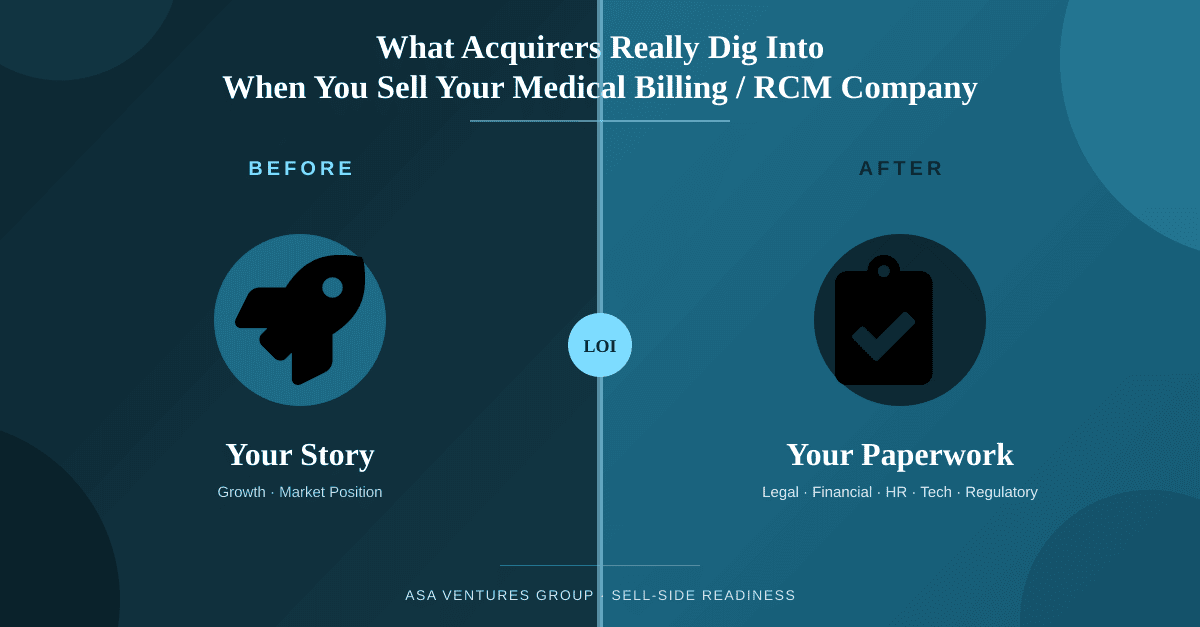
Recently, we helped a revenue cycle management company get acquired by a strategic acquirer. Thought it would be helpful to show how different diligence looked before versus after signing the letter of intent (LOI).
Before the LOI, it’s a conversation about your story:
Acquirers want to understand how you grow, not just that you grow. Expect pointed questions like: How do you 2x revenue organically, and what would you need to invest to get there? What’s your actual win/loss rate on new providers, why do clients leave? Which sales/marketing channels really drive pipeline, and could you input more and produce more? How concentrated is your revenue in a handful of large or consolidating clients, and what happens if one of them decides to bring the billing work in-house? Where’s the whitespace in adjacent markets, and how exposed are you to larger competitors or new technology entrants like AI?
After the LOI, it becomes a documentation/proof exercise:
Now the acquirer needs proof, not narrative, across five categories:
- Financial: revenue by client, AR aging, new-name vs. back-to-base splits, tax filings and nexus determinations.
- Legal: cap table, litigation history, IP ownership – our client had created their own CRM system so this was considered here, standard client agreements.
- HR: employee classifications, multi-state payroll compliance – compliance paying workers remotely in different states can hold up closing if not looked at early, benefits documentation.
- Technology: what’s proprietary vs. licensed, integration points, support contracts.
- Regulatory: HIPAA/HITECH compliance, security incident history, SOC reports, training records. This one gets particularly deep scrutiny in RCM, given the PHI you handle daily.
The pattern: pre-LOI diligence tests whether your growth story holds up under questioning. Post-LOI diligence tests whether your paperwork holds up under a microscope. Sellers who prepare for both – a sharp, numbers-backed growth narrative and a clean, current document set – move through the process faster and give up less in re-trading. If you’re a healthcare or RCM company owner thinking about a sale in the next 12-24 months, the best time to get ahead of both is now, while there’s no deal clock running.
At ASA Ventures Group, we help healthcare and RCM business owners get sell-side ready before they’re in a live process pro bono. Then our bread and butter is running a competitive process to get you acquired.